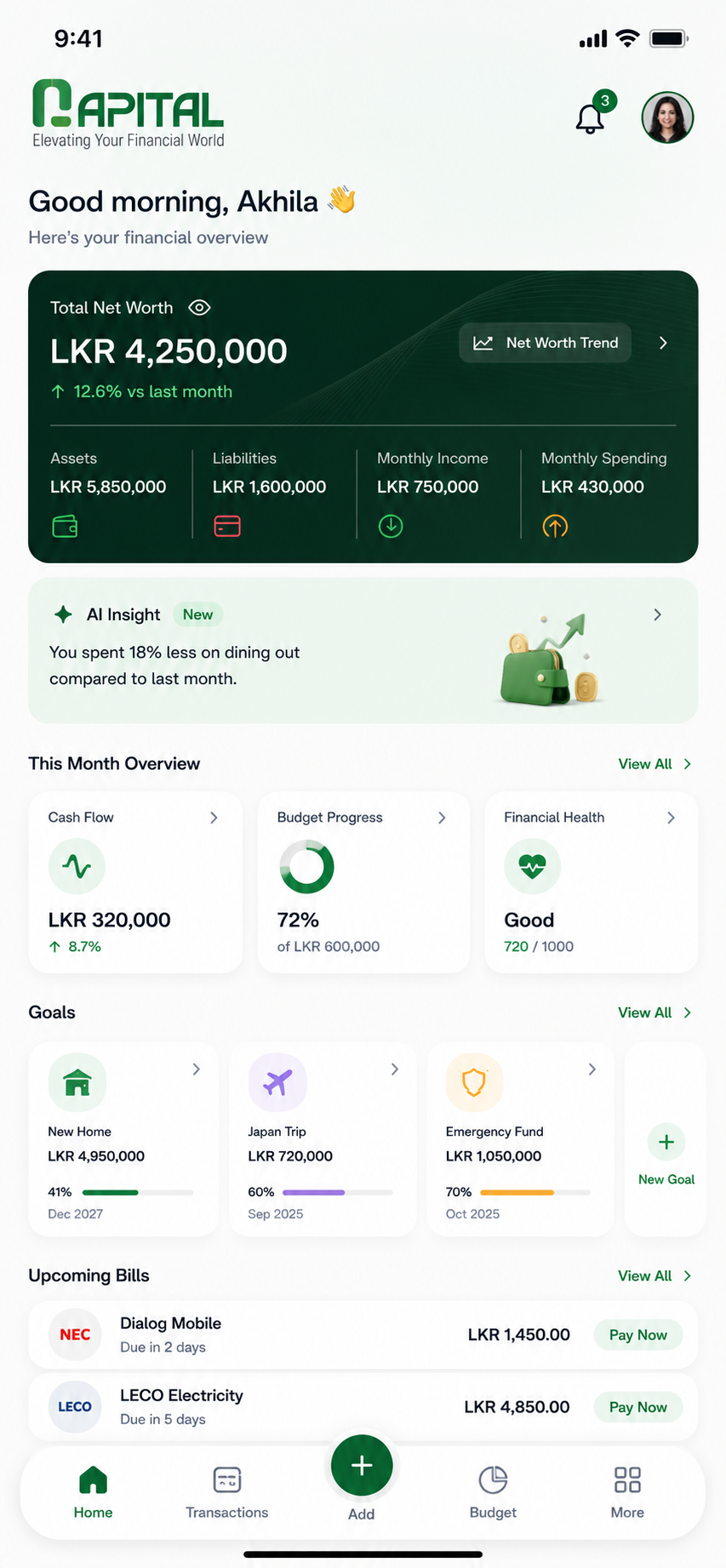
Qapital
Designing a personal finance platform that helps people understand, manage, and grow their money with confidence.
Managing personal finances often requires switching between banking apps, budgeting tools, investment platforms, and spreadsheets. Qapital brings these experiences together into one intelligent financial workspace, helping users understand their financial health, build better habits, and make informed decisions with greater confidence.
Responsibilities
Scope of work across strategy, structure, and interface design
- UX Research
- Information Architecture
- User Flows
- Wireframing
- UI Design
- Design System
- Interactive Prototype
Primary Users
User groups the platform was designed to support
- Young Professionals
- Families
- Investors
- Financially Conscious Individuals
Impact Stats
Give users a complete understanding of their financial health.
Help users save consistently and achieve long-term financial goals.
Encourage smarter spending through meaningful insights and guidance.
Bring banking, savings, investments, and budgeting together into one experience.
Many people struggle to understand their financial position because their money is spread across multiple accounts, budgets, and investment platforms. Qapital was designed to simplify financial management through one connected experience.
The Problem
Fragmented financial tools reduced visibility and increased complexity
Fragmented financial tools reduced visibility, increased complexity, and made it difficult for users to make informed financial decisions.
- Multiple banking applications
- Separate budgeting tools
- Limited financial insights
- Difficult goal tracking
- Poor understanding of spending habits
The Solution
A centralized platform with actionable financial insights
Qapital centralizes financial accounts, budgets, investments, and savings into one intuitive platform that helps users understand their finances through actionable insights.
- Unified financial dashboard
- Budget management
- Savings goals
- Investment tracking
- Personalized financial insights
Design Constraints
Balancing simplicity, trust, and information density
Designing financial products required balancing simplicity, trust, and information density.
- Constraint 01
Sensitive Information
Financial data required clear safeguards and trust-first presentation.
- Constraint 02
Complex Data
Complex financial information needed to remain understandable on mobile.
- Constraint 03
User Trust
Every decision had to reinforce clarity, transparency, and confidence.
- Constraint 04
Regulatory Context
Financial experiences needed to support compliance-oriented clarity.
- Constraint 05
Mobile-first Design
Dense financial workflows had to feel simple on a small screen.
- Constraint 06
Long-term Engagement
The product needed to support sustained behavior change over time.
Success Metrics
Expected outcomes used to evaluate product direction
These KPI cards represent expected outcomes rather than measured analytics.
User Journey
How Qapital improves each stage of the financial journey
- Stage 01
Connect Accounts
Unifies fragmented account data into one trusted foundation.
- Stage 02
Review Financial Overview
Surfaces key health indicators first for fast understanding.
- Stage 03
Track Spending
Makes spending behavior visible with clear categorization.
- Stage 04
Manage Budget
Supports smarter monthly planning with real-time visibility.
- Stage 05
Save Towards Goals
Builds consistency through progress-driven savings experiences.
- Stage 06
Monitor Investments
Keeps investment context connected to everyday finances.
- Stage 07
Receive Insights
Turns complex data into actionable recommendations.
- Stage 08
Improve Financial Habits
Encourages long-term behavior change through guided decisions.
Before Qapital
Fragmented tools increased effort and uncertainty
- Multiple finance apps
- Difficult budgeting
- Manual expense tracking
- Limited financial visibility
- Poor financial awareness
After Qapital
One connected experience for better financial decisions
- Unified financial dashboard
- Smarter budgeting
- Goal-driven savings
- Personalized insights
- Better financial decisions
Design Process
From behavioral research to scalable mobile product decisions
A structured process focused on financial behavior, planning workflows, and trust-centered mobile experiences.
- Step 01
Research
Understand financial behaviors, budgeting habits, and user goals.
- Step 02
Problem Definition
Identify pain points across personal finance management.
- Step 03
Information Architecture
Organize accounts, budgets, savings, investments, and analytics into a simple structure.
- Step 04
Interface Design
Design intuitive mobile experiences supported by reusable components.
- Step 05
Prototype & Iterate
Validate workflows and continuously improve usability.
User Personas & Needs
Understanding the primary users, their motivations, challenges, and how the product supports their goals.

Young Professional
Managing income, expenses, savings, and financial goals.
Goals
- Understand spending
- Build savings
- Stay on budget
Pain Points
- Multiple finance apps
- Poor visibility
- Difficult budgeting
Needs
- Dashboard
- Budget tracking
- Insights
Primary Tasks

Family
Manages shared household finances.
Goals
- Control spending
- Save for the future
- Track recurring expenses
Pain Points
- Shared budgeting
- Unexpected costs
- Financial complexity
Needs
- Shared budgets
- Goal tracking
- Expense management
Primary Tasks

Investor
Tracks investments alongside everyday finances.
Goals
- Monitor investments
- Diversify assets
- Balance portfolio
Pain Points
- Multiple platforms
- Manual tracking
- Limited visibility
Needs
- Investment dashboard
- Portfolio insights
- Analytics
Primary Tasks

Financially Conscious User
Focused on building healthy financial habits.
Goals
- Improve discipline
- Reduce spending
- Build wealth
Pain Points
- Poor habits
- Limited awareness
- Inconsistent saving
Needs
- Personalized insights
- Spending analysis
- Recommendations
Primary Tasks
Design Principles
Principles Guiding Product Design
- Simplify complex financial information.
- Build trust through transparency.
- Encourage positive financial habits.
- Surface insights before raw data.
- Reduce cognitive load.
Information Architecture
Financial-journey structure for lower workflow friction
The application structure follows the natural financial journey, allowing users to move seamlessly between accounts, budgets, savings, investments, and financial insights.
- Dashboard
- Accounts
- Transactions
- Budgets
- Savings Goals
- Investments
- Insights
- Payments
- Profile & Settings
Key Features
Core capabilities that improve financial planning and decision quality
Each module is designed to simplify complex finance workflows while encouraging better habits.
Financial Dashboard
Provide a complete overview of accounts, spending, savings, and investments.
Budget Management
Track budgets and spending patterns with real-time visibility.
Savings Goals
Encourage long-term financial habits through goal tracking.
Investment Tracking
Monitor investment performance alongside everyday finances.
Financial Insights
Transform complex financial data into simple, actionable recommendations.
Design Decisions
Decisions made to improve clarity, confidence, and usability
Each decision balances financial depth with approachable mobile interactions.
Dashboard
Prioritizes financial health and spending insights before detailed transactions.
Visual Hierarchy
Financial information is organized from high-level summaries to detailed breakdowns.
Progressive Disclosure
Advanced financial information appears only when required.
Reusable Components
Consistent design patterns improve scalability across future financial services.
Navigation
Persistent bottom navigation supports quick access to core financial activities.
Accessibility
Readable typography, spacing, and contrast improve financial data comprehension.
UI Highlights
Annotated screens showing why each region exists and how it improves financial decision making.
Design System Overview
Reusable components that support consistency and scale
A shared component system ensures scalable growth across future financial services while maintaining a consistent and trustworthy experience.
- 01
Buttons
Clear action hierarchy for high-confidence interactions.
- 02
Cards
Scannable summaries for accounts, budgets, and goals.
- 03
Forms
Structured data entry for setup and financial preferences.
- 04
Charts
Visual trends to support faster understanding of financial health.
- 05
Progress Indicators
Goal and budget progress states that motivate action.
- 06
Status Chips
Quick contextual markers for account and transaction states.
- 07
Navigation
Persistent bottom navigation for core financial activities.
- 08
Badges
Lightweight indicators for alerts, updates, and priorities.
Accessibility Considerations
Designed for clarity, readability, and confidence
- WCAG AA contrast
- Readable typography
- Large touch targets
- Clear hierarchy
- Keyboard accessibility
- Consistent spacing
Design Trade-offs
Rationale behind key product decisions
- Why dashboard-first? Users begin by understanding their overall financial health before exploring individual accounts.
- Why cards? Financial summaries are easier to scan visually than dense tables.
- Why progressive disclosure? Financial products should avoid overwhelming users with unnecessary information.
- Why personalized insights? Actionable recommendations create stronger long-term engagement than raw financial data.
Future Opportunities
Roadmap directions for continued product evolution
These opportunities represent future product evolution beyond the current concept scope.
- Roadmap 01
AI financial coach
Guided recommendations tailored to user behavior and goals.
- Roadmap 02
Cash-flow forecasting
Predict upcoming balance trends to improve proactive planning.
- Roadmap 03
Investment recommendations
Personalized portfolio guidance aligned with user risk profiles.
- Roadmap 04
Bill prediction
Anticipate recurring expenses for better budgeting accuracy.
- Roadmap 05
Shared family budgeting
Collaborative household planning with aligned goals and visibility.
- Roadmap 06
Subscription management
Centralized tracking to reduce waste and optimize recurring spend.
Expected Impact
Outcomes expected from unified financial management
- Improve financial awareness
- Encourage healthier spending habits
- Increase budgeting consistency
- Support long-term savings
- Build confidence in financial decision making
Key Takeaways
Lessons that shaped product and behavior design decisions
Designing Qapital reinforced several important lessons.
- Financial products should reduce anxiety rather than increase it.
- Data visualization is more valuable when paired with actionable insights.
- Trust is built through clarity, transparency, and consistency.
- Good financial experiences help users build habits instead of simply tracking numbers.
If I Had More Time
Next steps to evolve Qapital further
With additional time I would continue evolving Qapital through:
- Usability testing with diverse financial users
- AI-powered financial coaching
- Family finance management
- Subscription optimization
- Predictive cash-flow analysis
- Accessibility validation
- Expanded investment planning
Qapital demonstrates how thoughtful product design can transform complex financial information into meaningful experiences that help people build healthier financial habits with confidence.